Experience another level of customer service during a private shopping session.

Audio Emporium

QC

Quality Control. Everyone talks about it. Few companies pay real attention to it. Very few employ it to the Nth degree. Let’s take a look at how Bryston and Axiom are setting the bar high for speaker QC.

Construction Advantages

Bryston of Canada goes well beyond what its competitors do to assure that you’ll end up with highly resolving and durable speakers at your house.

As you read through these details you’ll get a concrete handle on what makes Bryston perform better and last longer. It is the implementation of many specific choices that allows Bryston to sound so good and provide a 20 year warranty. Axiom is built with the same QC, but its driver designs aren’t as powerful, hence its five year warranty.

Keep in mind, if you get tired while listening to your speakers, you’re getting fatigued by distortion. Bryston builds to generate muscular volume without distortion.

Tweeters

Bryston builds its own tweeters in house, by hand, in Canada. Almost all competitors source their drivers from vendors who blast out thousands of tweeters that they sell to a myriad of companies.

When you build them yourself, you can pay attention to details the mass makers simply can’t.

Tweeters have a thin wire voice coil. The industry standard is to have the tiny wire of this voice coil soldered direct to connection posts. Many companies just use clip leads. Bryston pays more attention to this fine detail.

Bryston takes the time to actually hand solder a tensile lead of aluminum to the tweeter voice coil. This lead acts as a heat sink for the voice coil AND makes for a much more solid connection to the + and – terminal posts of the tweeter.

As your tweeter gets hot and cools off over the course of many years, the voice coil is taxed, especially at the connection points. Bryston’s method of heat sinking as well as creating a more solid mechanical connection to the terminal posts, yields superior power handling and advantages in physical reliability for YEARS. Remember that 20 year warranty. This is one of the reasons Bryston tweeters are tougher than the other guys.

Bryston tweeters have been designed to accept high power without buzzing or breaking. The other guys invariably have tweeters that distort and misbehave as they’re challenged- even before they break. Bryston’s advantage goes beyond just “not breaking.” It continues to provide wide dynamic range without buzzing within its musical production. The other guys COMPRESS as they’re stressed. Bryston keeps going.

Bryston builds its own midrange and woofer drivers as well. These drivers are created with equivalent scrutiny.

Battery of Tests

Every Bryston/Axiom driver is graphed to insure that it measures within a scant variance of the REFERENCE of that driver. It won’t matter if you have serial number 1, 1000 or 10,000. They will all perform identically, for all perceivable purposes.

Each driver is required to pass this battery of tests before it can be passed along to be installed in an actual speaker.

*Amplitude response

*Impedance curve

*Phase

*Distortion

*Buzz & rub test to be sure mechanical integrity is secure

*Polarity

*Temperature

Bryston won’t install drivers without them passing these tests.

What do the other guys do? Even haughty brands buy drivers from vendors and simply screw them into boxes. They’re depending on their mass merchandising vendors to do all the QC. That’s a huge leap of faith.

The Chinese punch out zillions of drivers and use them all. If they PLAY, they’re used. You can end up with a pair of speakers where the right and left have tweets, mids and / or woofs that are different in output from each other by over 3dB. Think of the mess that will occur if your tweet is louder on the R speaker, the midrange is louder on your left, and who even knows what the Hades is going on with the woofers.

We crave precise detail and balance in our music. Bryston makes speakers like glasses with an accurate prescription. The Chinese in particular make speakers where the result is more blurry.

Bryston’s Torture Chamber

Not only is every driver required to meet a tight window of operation, the entire assembled speaker is tested as well. The array of drivers with crossover has to graph accurately to move on to Bryston’s infamous torture test.

Every completed Bryston speaker must survive a 24 hour torture chamber test. The speaker is assaulted for this duration with a 1500 watt amp at double its rated power. The test is a roller coaster ride with Lucifer and any speaker that reaches our door gotten out alive!

R&D

Bryston has done extensive R&D to attain stronger power levels than what is the norm in the industry. Bryston engineers have spent many hours at the Ottawa National Research Council, which hosts state of the art facilities and equipment to do deep dive research on speaker components.

Bryston has actually built a replica of the NRC’s anechoic chamber in its own house to make important discoveries with unlimited time at their disposal.

As you stand within this anechoic chamber you can hear things that you CANNOT when you’re outside the chamber. You can hear your own breathing and even heartbeat- that you have no sense of outside the chamber. This dead silent noise floor lets Bryston measure speaker mechanics and performance to a more precise degree than companies who don’t have access to a test lab like this every day, 24/7.

Double Blind Testing

Bryston has a listening room where it does double blind testing. They put speakers behind a sheer black curtain and have listeners rate characteristics of the speakers they’re listening to. On top of listening ratings, Bryston asks listeners to make specific comments on what they like, or don’t like.

This room also allows Bryston to get listeners’ perceptions on A-B comparisons of specific crossover changes and components. That’s right. Bryston isn’t just comparing Bryston to other brands of speakers. Listeners can hear Bryston speakers with several crossover configurations immediately in an A-B comparison. This allows minute fine tuning that you simply couldn’t do without this valuable tool at your disposal every day.

Bryston has determined that this level of testing is quite accurate. They can tie test measurements reliably to what people prefer. It isn’t like measuring taste buds. The result is much more like testing eye sight. Bryston says its listening panel is often 80% in unison on liking a particular upgrade.

Bryston’s 100 Foot Tower

Bryston built a 100 foot tall tower to measure its speakers’ bass response accurately from 100Hz down to 12Hz. You cannot get precise bass measurements in normal room, or even an anechoic chamber, due to the long travel of bass waves. Bryston can measure bass performance exactly, without these measurements being colored by the room itself.

In its R&D Bryston has run every model up the tower to test its bass finger print. With this test information in hand Bryston can design a crossover quite specifically for the model in question to attain deep, yet taut bass response. Bryston speakers are renown for deep, tuneful, non muddy bass. This tower is a valuable tool that Bryston uses for every model it makes. The fact is, the other guys are largely guessing at the bass performance they’re producing. That’s why most speakers are conspicuously muddy and ill defined in the lower regions.

Bryston Cabinet Building

Bryston doesn’t buy its cabinets from a vendor. They make them, starting with Canadian Rangerwood, which is locally sourced and more impenetrable than the MDF used in China. The wood is dense and smooth which enables it to be precision formed- to within a .2mm tolerance. This exacting manufacturing technique yields sonic results along with attractive cosmetics.

Over the years we’ve had mass produced speakers from other vendors reach our doors with a rattle. We know to listen for this when we unload trucks. We’ve opened the carton, unscrewed the woofer to discover chunks of hot glue bouncing around the box like a ping pong ball. At least the customer buying from Audio Emporium would be sure not to end up with such sloppiness. If you order online, there’s nobody in the road to save you from such perils.

Printed Circuit Board Construction

Bryston builds its own PCBs. They populate PCBs and run them through their own solder bath to assure solid continuity. Some competitors will argue that their point to point hand soldering is better. IT ISN’T- despite what they tell you. Building your own PCBs instead of buying them from a vendor is yet another detail Bryston has a handle on- that most of the other guys don’t.

Metal Working

Bryston has its own metal working shop. This is valuable for a plethora of mechanical advantages. Bryston achieves strength and smooth interfaces where the other guys rely on job shops.

Paint Room

Bryston has its own paint room where it can consistently create what they’re trying to achieve. They’re not relying on vendors for cabinet or metal work finishing. Bryston’s standard finishes of black ash and walnut have been outstanding for over a decade. Newer finishes like Boston Cherry (red-ish) and walnut expresso (dark walnut) have been winning raves from our customers too.

The Other Guys

The BEST you’ll get from the other guys is that they’ve tried to buy good drivers from Scans-Speak or Seas in Scandinavia. More likely, they’ve purchased a much lower level of drive element from China or Malaysia.

They’re taking these drivers out of boxes and screwing them into cabinets they likely bought from a vendor, or in some cases built themselves.

What you end up with at your house is POT LUCK as parts were unpacked and assembled. With Bryston, you get a finished product you can count on every time.

Dave’s Faves – Atoll IN400 Integrated Amp

Atoll IN400 Integrated Amp, $7000 (160×2)

{5.11h, 17.32w, 14.17d, 43 lbs}

Atoll’s IN400 is a true contender for state of the art integrated amp. I say that without reservation. IN400 is right there with the best of the best, regardless of price. You can buy amps from Switzerland pushing $50k that won’t have the weight and warmth of IN400. Did you know some of those amps use SMPS power supplies? Yuk. Atoll runs linear power supplies, of course.

IN400 runs $7k in line stage configuration. If you don’t need a DAC or phono section built in, buy IN400 as is and you’re ready to go.

If you want the DAC board built in, DA100 runs $300.

If you want MM phono built in, P50 runs $130.

Both of these are excellent options despite their low prices. The prices are low because the infrastructure of these boards is within IN400. When you buy a stand alone DAC or phono section, you have to pay for the chassis, buttons, jacks, power supply- from square one. I think the built in boards are an excellent value. But if you’re an a la carte guy and want to run something else, it’s your choice.

If we were to blindfold you in your chair and do an A-B comparison with a myriad of price no object integrateds, IN400 would win in many categories of aural performance. Considering its state of the art competitors run $20-30k on up, IN400 is the best actual purchase option of the bunch. In fact, most integrateds at this price point are built in Chinese job houses with Euro names on them. Sheeze!

Atoll IN400 rear

Atoll is built in Atoll’s factory in France with a three year warranty. It isn’t designed in France and built in China. Some companies that contract Chinese vendors to build for them put “France” on the back panel, which is different from “Made in France.”

Nor is Atoll a pile of Chinese parts assembled in France to try to fake you out with a label that says “Assembled in France.” When you scrutinize the back panel of what’s out there, you’ll see this blatant deception frequently.

Atoll is an honest to gosh, family owned company in a day and age where most of its competitors are subsections of hedge funds. Atoll delivers a level of TLC that the other guys simply can’t.

Power Supply

Atoll IN400

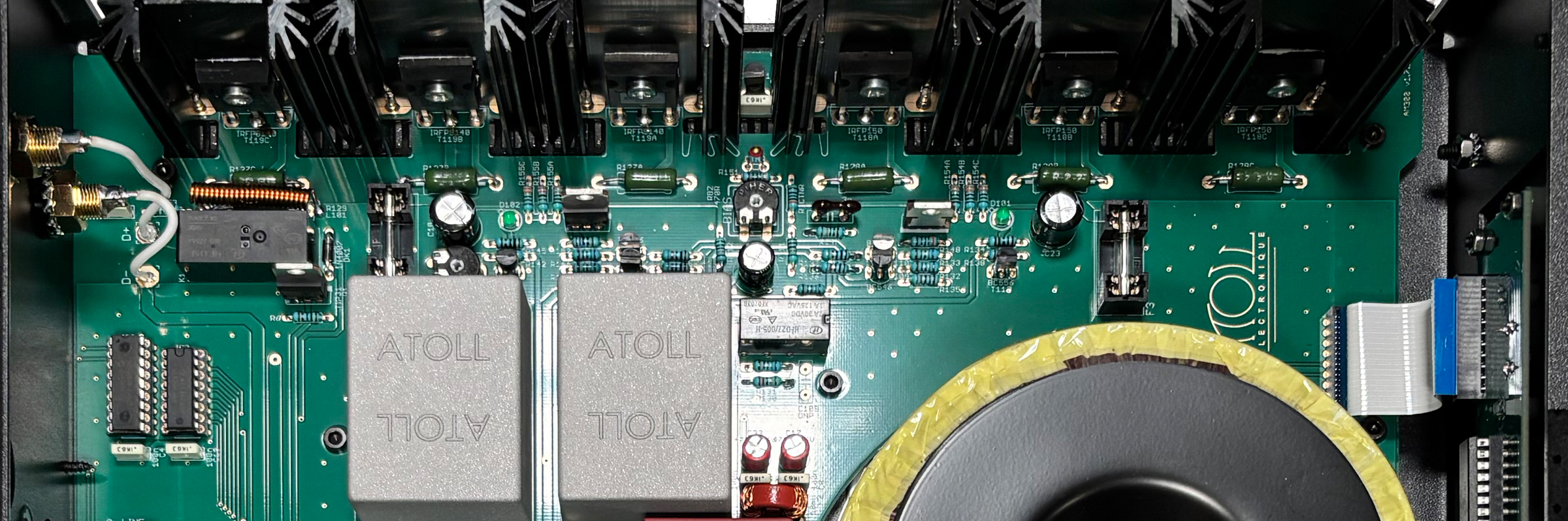
The heart of IN400 is its power supply. It starts with a ginormous 1050VA transformer that Atoll has designed and has built for them in Spain. It is an internal dual mono structure. It has separate windings for each channel. It uses a second 1.6VA transformer for control logic.

The filter caps are also designed by Atoll and are custom built for them in Japan. IN400 uses almost 100,000uF in power supply caps to help deliver a rich and weighty musical character.

Chassis
IN400 is mechanically stout. Its face plate is just under one half inch of micro-blasted and anodized aluminum, with high precision engraving. The chassis is made of steel. Heat sinks are machined aluminum construction.

Matched Output Transistors

IN400 runs 8, MATCHED MOSFET output transistors per channel. This is a vital part of Atoll’s TLC. Imagine you have a tuning fork tuned to middle C. Then you add another and play them simultaneously. If they’re not precisely the same- you incur distortion artifacts from the differences between them. It’s impossible to make two PRECISELY the same.

Relay this analogy to an amplifier’s performance. If you run, in this case, 16 output transistors, all buzzing away at their own whim, you’re guaranteed to get harsh results. Atoll takes the time to hand match its transistors so you’ll achieve a more ebullient character in your music. This explains why, historically, higher powered amps sound more grungy than their lower powered siblings. The more power and transistors you have, the more grainy the amp will sound due to the mismatched transistors.

Atoll takes assiduous effort to be sure its more powerful amps are just as mellifluous as the rest of the family. You pay no penalty for greater horse power with Atoll. With virtually everyone else, the bigger they are, the harder they…. Sound.

Open/Airy Presentation

With this long-winded preface behind us… it is in a singer’s voice that IN400 first grabs me. Toss on a buoyant singer with acoustic guitar (Joan Armatrading “Love & Affection”) and be prepared to hear resolution and ambiance galore. Joan’s breathy delivery is a thrill to hear! Plenty of amps will play this “cleanly.” But to imbue the soundstage in front of you with so much space and air takes on ethereal beauty. It made me think of fireplace bellows of massive capacity vs flimsy ones. Run through a variety of great speakers (Bryston, Magnepan, Atohm) I know very well, they all sounded more capacious with IN400 than anything equal or less money.

IN400 delivers this lovely level of open/airy sound- without adding a hint of BRIGHTNESS up top. This weighs heavily in my recommendation of Atoll. We get the spacious soundstage without an edgy high end. If you have crispy sounding electronics playing through tremendously revealing speakers like Brystons, Pans or Klipsch Heritage- your ears might get sunburned. Drop in the IN400 and these speakers have detail sans BITE.

IN400 will please any tube lover with its tonality. You’ll derive this warm fluidity and 3D soundstage without the heat, hassle and noise endemic to tubes. I’ve tried a myriad of tube amps with the revealing speakers mentioned above. Never… can I get past the unacceptable noise floor. As a fan of classical piano and female singers with sparse backing, I have no tolerance for the hum/hiss that rides along with the music.

IN400 has a muscular low end- much weightier and more convincing than any D designs. It’s more powerful and controlled than any tube amp. Its balance is hefty and impactful which will allow any speaker to reach its max level of dynamic impact and excitement.

While no amp is perfect, we’re always looking for the best performance we can achieve at a given price point. What makes IN400 my fave is that it curates the MOST IMPORTANT vocal region (whether humans, pianos, acoustic instruments) better than any integrated I’ve heard.

IN400 does this without a raspy top end or thin bass response. I don’t want tubes with their heat, noise, sluggish bass and poor reliability. IN400 is a ground breaking integrated at an attainable price for people (like us!) who value singers, pianos and the sound of exquisitely crafted acoustic instruments.

IN400 Deserves The Best Speakers

As I’ve gotten to know IN400 well, its strength is in bringing more air, space and weight to EVERY speaker it pairs with. What are some speakers that are worthy of IN400?

I start my list with the Bryston T Series. The Gibraltar-ish 8” woofers within the T Series have stupendous capabilities and weight. Bryston Middle T and Model T are just begging you for IN400- the perfect handshake.

Maggie 2.7s and north benefit from IN400’s conspicuously high level of refinement and power.

The Mags with true ribbons play well with IN400’s smoothness. Their bass becomes big and bold with IN400’s bulging muscles.

Atoll’s IN300 does a fabulous job for the money. IN300 hits the Point of Diminishing Returns for most customers.

IN400 is for listeners with the most revealing of speakers. If you have anything less, get IN300 and invest in better speakers.

When you listen to speakers a notch down from Bryston T Series or Maggie 2.7s, it’s fair to say IN300 brings 95% out of them. It wouldn’t be a waste to run IN400 with Bryston As or Maggie MG 1.7i’s. But IN400 is a step higher and stronger- if your speakers can take advantage of it.

I have a few words to say about Atoll’s implementation of its AKM DACs. The DAC performance of IN400 with the DA100 board installed, is clean yet smooth. Atoll runs the AKMs without negative feedback. Please be aware that the latest greatest chipsets that brag up higher processing power, universally sound brighter and leaner than how AKM performs within Atoll. More processing doesn’t yield a more musical sound, any more than cranking up the contrast control makes a TV look better.

IN400 earns its space with the most revealing speakers you can get. If you have top tier speakers or are planning to get some down the road, IN400 is right up your alley. Bryston T Series, Maggies with true ribbons and Atohms are at the top of the list for being ethereal and capable of big power- IF your amp can bring it. IN400 surely can!

Adcom GFA555

Bryston Impresses In Montreal

IsoTek Systems

Isotek is an English company, specializing in Power Conditioners and Power Cables that they manufacture in Europe. The goal of Isotek is not to just provide surge protection, but to provide IMPROVED SOUND for your hi-fi or AV system.
There are two main sources of noise that muddle up your AC.
Differential Mains noise is debris caused by all electronic appliances connected in your house. That includes TV, microwave, phone chargers, anything that plugs in.
Common mains noise is debris caused by RFI, interference you can’t see. We all have such debris from cell phones, wifi and other sources.
Job one is eliminating these sources of noise.
All of the Isotek conditioners deal with both issues, eliminating Differential and Common Mains noise. Most importantly, Isotek does this without squashing the dynamics of your sound.

Separate Isolation

With Isotek power conditioners, no two outlets are wired together (even Polaris) and once you get to Aquarius, each outlet has its own dedicated filter network. This eliminates cross contamination of your components’ power supplies and delivers equal power delivery and resistance to each outlet.
The other guys… strap all outlets together. Each outlet will be negatively effected by the other devices that are plugged in… this is even common practice on very expensive models.
Each component’s power supply creates noise, especially on switch mode PSUs. Cross contamination between components masks micro dynamic detail and harmonics. The effect of cross contamination is more deleterious than the noise coming from the wall. This is a serious design flaw that nearly every other manufacturer overlooks. All you need to do is listen.

Simplicity

Isotek uses high quality parts and only as many as are needed. Their circuit designs are beautifully laid out using the shortest signal paths possible and proven engineering principles such as star grounding. Its noise filtration increases dynamic range and doesn’t impede current. That’s why your system will sound more dynamic plugged into an Isotek.
The other guys…stuff their boxes with lots of junction points, low cost/low quality parts and materials and complicated circuit layouts. This often creates more problems than it solves. You get higher impedance and lower current delivery resulting in a flat, boring sound. It also means each outlet will have different current delivery and different resistance. This leads to compromised performance for the components that get plugged in to the “worst” outlet.

VDRs – MOVs

The other guys… use a single large MOV for surge protection. While this can take the initial impact it will still let some of the surge through to your components. It also tends to squash your system’s ability to reproduce macro dynamics because it is too heavy handed.
Isotek uses a more reliable sequential array of specialized VDRs to protect equipment from the over voltage while not effecting audio quality.

IsoTek Aquarius

Aquarius $1995

Aquarius is a 6 outlet Mains Conditioner than can improve the best of systems. With stronger protection and higher current capability than its smaller brothers, Aquarius is the sweet spot in the line and can fit in the best of systems, Bryston, Mac, whatever! It provides a blacker background, cleaner mid and high level information, and stronger, more controlled bass. It is ideal for monster power amps including monoblocks.


IsoTek Solus

Solus $995

Solus is a 6 outlet Mains Conditioner and and is a noticeable step up in performance from Polaris. It comes in a component width chassis to place with your other gear. It does everything Polaris does, but to a greater degree, resulting in better audio performance and flexible placement.


IsoTek Polaris

Polaris $495

Polaris is a 6 Outlet Bar that will improve your sound quality at a modest price. Each outlet is wired independently to the power conditioner network and surge protection circuit. Polaris provides serious surge protection in the process. The audio improvement is clearer sound, with deeper, tighter bass. It’s a real bargain for under $500 and the perfect starting point for improving your system’s performance.

Power Cables

Some people think power cables don’t make a difference. You will believe otherwise when you
hear Isotek cables! Isotek uses 6N copper and high quality connectors.


IsoTek Initium

Initium $100

14g power cable with 6N Copper conductors within a poly dielectric. Connectors are made of nickel. Initium will make an upgrade in your sound!


IsoTek Premier

Premier $150

Premier is the power cable you really want. For $50 more it is a 14g cable with silver plated 6N Copper within a Teflon dielectric. Connectors are gold plated. Premier smokes traditional black power cables and YES, you can hear the difference!

Here’s a great video on the product!