
10-1-26
ATC Active Speakers
ATC of England makes Active and passive speakers. The Active versions sound much better and are the way to fly if you’re spending $14k- ish, or more. Again, that price includes the speakers and 3 amps in each tower.
You will get a better grip on your speakers by going ACTIVE. The drivers start and stop faster with active vs passive.
In an ACTIVE design, each speaker has an electronic crossover on board and three amps (for a 3-way). The electronic crossovers can be set quite precisely for frequency points and phase accuracy. Then the amps directly drive the speakers.
In a passive system, no matter who makes it or how much it costs, even six figures, your expensive amp has to fight its way through a boatload of passive parts. All those parts can do is cut or diminish the “water pressure” going to your speakers.
I look at the magazines every month and shake my head. Article after article “pushes” ginormous amps and speakers for hundreds of thousands. Large speakers can have 20 pound crossovers with zillions of feet of wire for your music to fight through.
Active, is a much better way to go.

SCM40A runs $14k Per Pair

SCM50 ASLT runs $27k Per Pair
ATC’s 3-ways use their magnificent dome tweeter and midrange drivers. I want you to buy one of those- vs saving a few pennies and buying a cone system that doesn’t sound as good.
As you get deeper into the hobby- please head the active direction. No matter how much you spend, you can’t get as good sound running big amps through big speakers, with passive crossovers-that have hundreds, or even thousands of feet of wire in the path.
9-1-26
As I’ve written in a number of postings on LATEST, there is a proclivity for manufacturers to try to shoot the moon on pricing these days. The absurd pricing on so much gear… knows no limits. It seems the market offers crazy high end stuff for the haves, and badged Chinese gear for people who actually work for a living.
This entry is to make sure you don’t miss, that there is a magnificent MIDDLE GROUND. You don’t have to buy insultingly expensive high end gear OR limit your choices to cheaper gear punched out of Chinese job houses.
There’s a wonderful niche market of exquisite electronics and speakers coming from France in particular. Please take a deep dive into what Atoll and Atohm of France are doing in terms of value.
Atoll
Atoll runs a bit more money than the Chinese gear. But, it is built much better, sounds much better and will have significantly superior reliability than what’s coming from China.
Let’s start with affordable amplification. Atoll offers class shattering integrated amps that should be the heart of most real hi-fi systems.
The same TLC that goes into Atoll integrateds goes into Atoll CD players, streamers and separates. I’m only spending time on the integrateds here. Please be sure to check out the rest of their offerings.
IN50, $1350 (50×2)

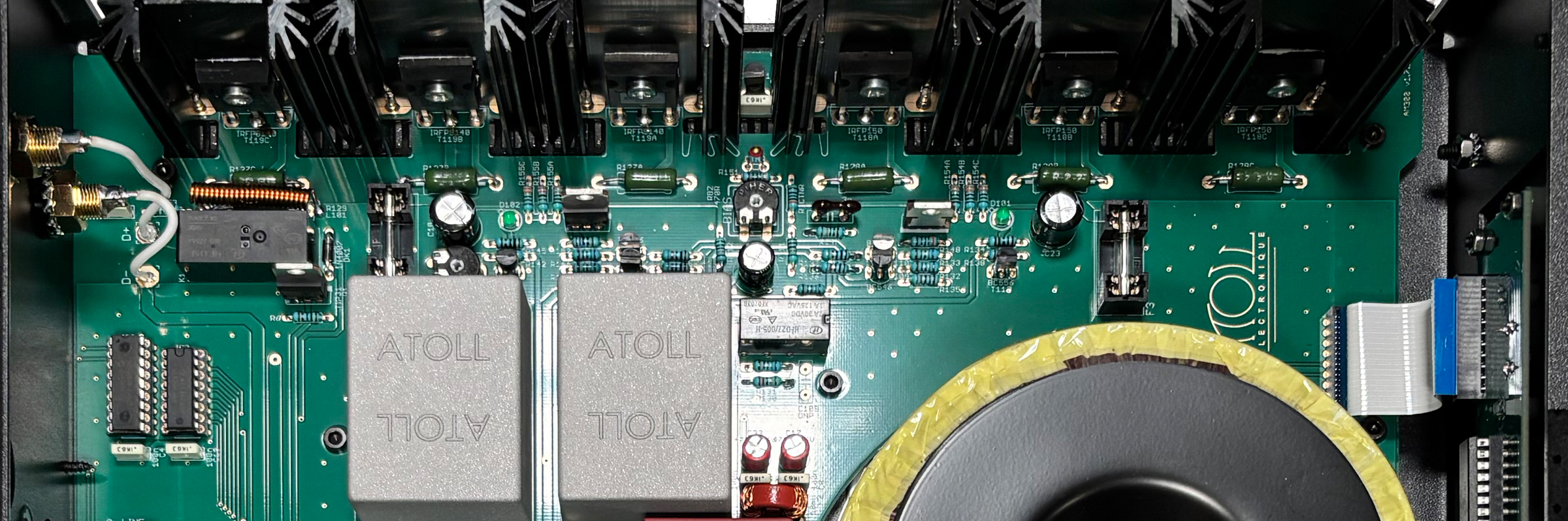
This 50×2 class AB integrated is a distinct cut above all of the similarly priced Chinese gear. It uses a hearty 170VA transformer, filter caps of 18,000uF and four MATCHED MOSFET output transistors.
The beefy transformer with big caps will provide a heavier, warmer sound than all of the Class D or skinny AB competitors coming from China. IN50 will give your speakers deeper, stronger bass than a 150×2 class D integrated from China!
The discrete MOSFET transistors are matched- so you won’t hear the distortion that is endemic from mass merchandise. In mass production transistors are purchased by the thousands and screwed into place as quickly as possible. Atoll actually hand matches transistors so they are used with precise mates. When you just plug in transistors without matching, you hear the distortion of a wide range of performance. Think of one transistor as a perfectly straight line. As you add others, the lines wiggle and wobble. Any transistor that doesn’t perform as the straight line contributes to
the distortion you’ll hear in your music. Mass merchandising can’t take these concerns into account.
No matter what speakers you’re running, IN50 will give you a more muscular sound, especially at lower volumes. You can expect your Atoll integrated to run for a couple of decades while the Chinese gear is lucky to last a couple of years.
The Chinese gear has more features than you can shake a stick at, because they’re comprised of a boatload of chips. Atoll is NOT. Atoll uses these large components I’ve spelled out and builds with through hole construction- vs a myriad of chips.
Atoll’s PCBs are laid out by computer, symmetrically, so there is no running wire in the circuit. The Chinese slap modular boards wherever they fit within the chassis and tie them all together with spaghetti like wire- promulgating RFI noise- connecting junctions with Molex style car stereo plastic heads.
The level of detail Atoll builds with, yields cleaner, quieter and more warm/powerful sound that you can appreciate with ANY speakers.
IN80, $1950 (80×2)

IN80 uses a single 340VA toroidal transformer with 32,000uF of power supply caps. It’s IN50’s bigger brother. IN80 has more dynamics and punch than IN50.
IN100, $2500 (100×2)

IN100 runs a PAIR of the 340VA transformers above. Weightier sound yet.
IN200, $3500 (120×2)

To ME, IN200 is where real uber sophistication starts. We’re no longer just beating the Chinese with IN200. IN200 uses a pair of the 340VA transformers, has 60,000uF of filter caps
and four MATCHED MOSFETs per channel, vs two per channel on its smaller brothers. IN200 uses
MKP caps in isolated mumetal boxes. It has a superior volume control.
With IN200 we can consider products far north of this price range. There’s a world of much pricier gear from Bryston, McIntosh and the wildly expensive European competition. IN200 is SO GOOD that if you were to compare the sound while blindfolded… you wouldn’t be sure anything more pricey than IN200 is worth the money.
While I luv all the Atoll integrateds for what they are, I’d say IN200 is the sweetest spot that takes you a higher echelon.
IN300, $4700 (150×2)

IN300 is just a bigger bro to IN200. It runs a pair of 440VA toroids, 86,000uF caps and a dozen MATCHED MOSFETS. If you need more than IN200, here ya go.
IN400, $8200 (160×2)

IN400 is a true contender for best integrated amp out there. There are more, bigger, stronger parts than IN300. There are a bunch of other manufacturing details with IN400 to make it on a par with Euro integrateds that sell for $25k on up.
Atohm
There are thousands of speaker brands. The fact that there are so many proves that someone likes each one.
What I can tell you is that the VAST majority are built in China by speaker houses. You can find very similar drivers in hundreds of brands of speakers. These vendors are smart enough to market well. They will put these generic parts in a plethora of aesthetics and brand names. You will find a given house can make literally dozens of brands- like golf shirts with different designs and logos.
Atohm is different in that it makes its own drivers and its own cabinets/crossovers in house. When you get an Atohm speaker, the drivers have been manufactured to within .25dB. Competitors are not worried about being this precise. You can read reviews where the Chinese in particular, have drivers (tweeters for example) that vary +/- 3-6dB in performance. Listening to Atohm speakers is like looking through glasses with a precise prescription. Everything is CLEAR. Listening to most competitors is “fine.” They sound pleasant or punchy. But you can’t “see” every leaf on the tree. You can only “see” the tree.
Atohm builds this level of precision in every model in the family.
Sirocco Series
The .24 models tell us the speakers were DESIGNED in 2024. They started being shipped in 2025 and should enjoy a long run as the most affordable speakers in the family. The wood finishes are lovely.

1.24, $2750 Per Pair
6” 2-way stand mount. It has outstanding clarity and more bass than you would dream from this size of cabinet.

2.24, $4250 Per Pair
Running a pair of 6s in a 2.5 way design, 2.24 casts a startling large image. It has clarity like flat screens with deeper bass and are easier to place.
Sirocco Center $2100
The matching center for theater use.
GT Series
GTs have a warmer/deeper presentation than Siroccos. Further, GTs have more beautiful voicing than the broad market of “shiny” sounding speakers. Most brands want a bit of zip on top to grab your attention. THAT is doubled edged sword. It can grab your ear on electronica, but become annoying on acoustic instruments and the human voice.
There’s a mountain of information to read if you like to deep dive. I have this within the Dave’s Faves listings.

GT-1, $5000 Per Pair
This 6” 2-way has the refinement and muscle of a B&W 805D4 ($14k per pair). Yet GT1 has an advantage in that its drivers are TOUGHER and the speaker plays louder. Beware of any speaker with diamond dust in the tweeter design. They can sound nice but reliability is a pricey concern.
Anytime you blow a driver the manufacturer has the right to say it’s your fault. You clipped your amp and over drove it. For decades virtually all companies realized it was just good biz to replace blown drivers as the price of good business- when the speaker was under warranty.
For the past decade it’s been a more cruel world. If you blow an expensive diamond dust tweeter from B&W or anyone else, you are going to be told YOU BLEW IT. The problem is not due to a manufacturing problem. Hand over $2k plus for a single tweeter.
GT-2, $8500 Per Pair

What an AMAZING mid sized tower! Running a pair of 6s and tweet in a 2.5 way design, GT-2 has sophistication and power galore. GT-2 provides muscle without boom. It images well beyond the scope of its cabinets. Buyers never add a subwoofer. GT-2 is the speaker, more than any other, that supplanted flat screens in our shop. It has clarity right there with pans and stats. It has much better bass and volume capability. It is easy to place and is gorgeous, especially in piano black, says me.
GT-3, $14,500 Per Pair

GT-3 is nothing short of magnificent. It’s not just a true 3-way, but uses a state of the art midrange driver that its brothers above don’t. GT-3 creates marvelous resolution, deep bass and maintains a silky smooth top end for us violin lovers. GT-3 runs half the price of the least expensive towers from brands like Wilson and Magico- and outperforms them.